


Silver markets made a decisive move on Christmas Day. In contrast to the subdued trading in Bitcoin amid thin holiday liquidity, silver prices in China reached record local levels, driven by constrained physical supply and robust industrial demand. The spike highlights a growing disparity between traditional hard assets and digital alternatives.
As supply pressures persist and geopolitical uncertainty intensifies, investors increasingly favor tangible stores of value, redirecting capital toward metals like silver. This trend highlights the enduring appeal of commodities that combine industrial utility with monetary characteristics, even as cryptocurrency markets remain susceptible to liquidity constraints and speculative cycles.
Read More: EU to Enhance Financial Literacy and Expand Investment Opportunities for Citizens
China’s Physical Silver Shortage Fuels Record Prices
The recent surge in silver originated in China, where local prices hit record highs on December 25, reflecting a clear shortage of physical supply. Globally, spot silver has hovered near all-time highs around $72 per ounce, extending a rally that has lifted prices more than 120% in 2025.
Gold has also posted strong gains, up roughly 60% this year, while Bitcoin retreated in December after reaching a peak above $120,000 in October.
Chinese spot and futures markets have consistently traded at premiums to London and COMEX benchmarks. In some instances, contracts briefly entered backwardation, signaling immediate supply stress. Given that China accounts for over half of global industrial silver demand, local shortages carry worldwide implications.
Several factors are driving the tightness. Solar panel manufacturing remains the largest contributor, while electric vehicle production continues to expand—each EV consuming significantly more silver than a conventional car, particularly in power electronics and charging infrastructure. Simultaneously, grid expansion and electronics manufacturing have sustained elevated demand.
Bitcoin’s Christmas Stagnation Highlights Market Divergence
Bitcoin, by contrast, remained largely flat on Christmas Day. Prices moved sideways amid thin trading volumes, reflecting lower institutional participation rather than a change in underlying fundamentals. The absence of defensive inflows is notable, underscoring how Bitcoin has increasingly behaved as a high-beta liquidity asset rather than a crisis hedge.
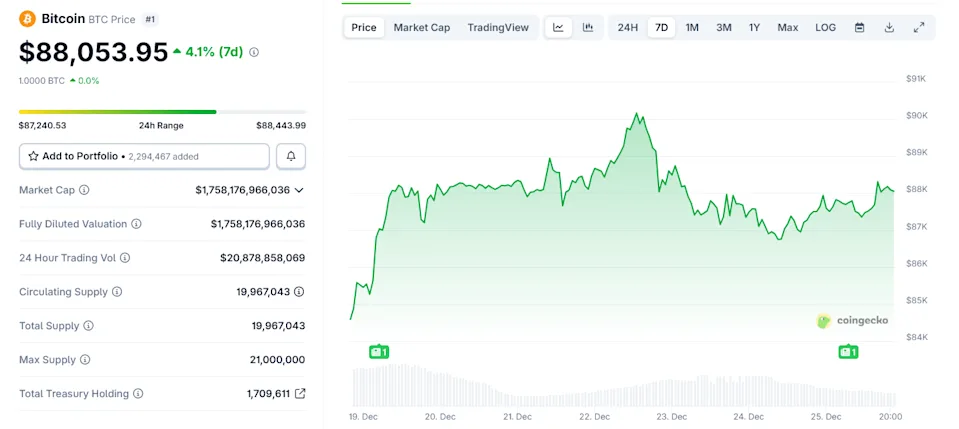
As physical scarcity and supply-chain pressures dominate market sentiment, investors continue to favor tangible metals over digital alternatives. Geopolitical risks reinforce this dynamic. Rising defense expenditures tied to conflicts in Ukraine and the Middle East have boosted silver demand in military electronics and munitions, further highlighting the contrast between traditional hard assets and cryptocurrencies.
Frequently Asked Questions
Why did silver surge in China?
Tight physical supply and strong industrial demand, especially from solar, EVs, and electronics.
How does China’s shortage affect global markets?
China drives over half of industrial silver demand, so local scarcity pushes global prices higher.
Why didn’t Bitcoin rise too?
Low holiday liquidity and weak defensive inflows; it’s behaving more like a high-beta asset than a hedge.
How does geopolitical risk impact silver?
Increased defense spending raises silver demand for military electronics and munitions.
What drives industrial silver demand?
Solar panels, electric vehicles (which use more silver than traditional cars), and electronics manufacturing.
Is gold following the same trend?
Yes, gold gained roughly 60% in 2025, benefiting from scarcity and geopolitical uncertainty.
Conclusion
The divergence between silver and Bitcoin highlights a broader market dynamic in late 2025. Physical scarcity, strong industrial demand, and geopolitical tensions are driving investors toward tangible hard assets, with China’s silver shortage sending ripples across global markets. Meanwhile, Bitcoin’s muted holiday performance underscores its role as a high-beta, liquidity-sensitive asset rather than a reliable crisis hedge.
