

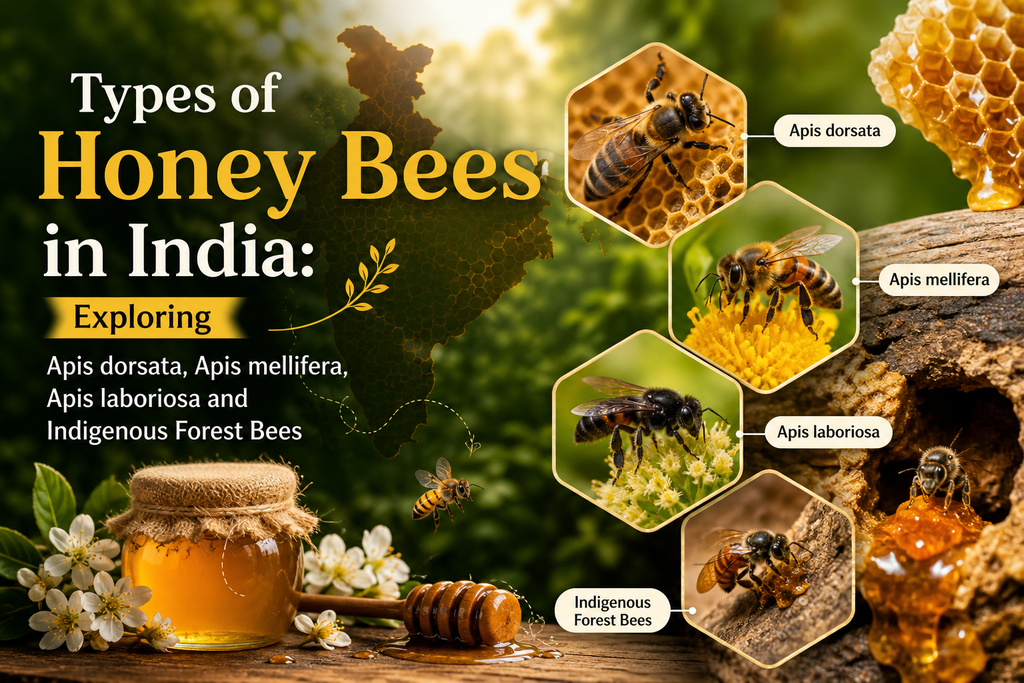
India’s honey heritage extends far beyond the familiar jars of golden honey found on supermarket shelves. From the towering cliffs of the Himalayas to the tropical forests of central India and the mangrove ecosystems of the Sundarbans, different bee species interact with diverse flowering plants to create remarkable ecological and commercial opportunities.
Understanding the different types of honey bees helps explain why honey varies in colour, aroma, texture and flavour. It also reveals the relationship between biodiversity, traditional honey harvesting, scientific quality assessment and sustainable rural livelihoods.
Among the most significant species are Apis dorsata, Apis mellifera, Apis laboriosa and Apis cerana. Smaller indigenous bees, including Apis florea, Apis andreniformis and stingless bees commonly called dammer bees, are equally important to the ecological story of Indian honey.
For consumers exploring premium raw forest honey, these distinctions provide a valuable starting point for understanding where honey comes from and what makes each variety distinctive.
Apis dorsata: The Giant Rock Bee of Indian Forests
Apis dorsata, commonly known as the giant honey bee or rock bee, is one of India’s most important wild honey-producing bee species. It occurs across a broad range of tropical and subtropical habitats, including forested landscapes, rocky cliffs and tall trees.
Unlike honey bees commonly maintained in artificial hives, Apis dorsata builds large, exposed, single-comb nests. Colonies may occupy high branches, cliff faces and other elevated locations that offer protection from disturbance.
These bees are highly defensive and are not generally suitable for conventional domesticated beekeeping. Their colonies also move seasonally in response to changing environmental conditions and the availability of flowering plants.
How does Apis dorsata honey differ?
The flavour and colour of Apis dorsata honey depend on the nectar sources visited by the colony, the season of collection and the surrounding vegetation. Honey collected from different forest ecosystems can therefore have distinctly different sensory characteristics.
Depending on its floral origin, forest honey may display:
- Deep amber to dark brown colours.
- Rich, robust or mildly smoky flavour notes.
- Complex floral aromas.
- Variations in sweetness, acidity and crystallisation behaviour.
These characteristics are not universal properties of the species. They depend on the honey’s botanical origin, moisture content, storage conditions and handling.
Wild honey harvesting also has an important human dimension. In many Indian forest regions, traditional honey hunters possess detailed knowledge of bee behaviour, seasonal flowering patterns and local landscapes. Their experience can contribute to responsible harvesting practices when supported by suitable training, safety measures and conservation awareness.
Royal Bee Brothers works with local and tribal communities across multiple forest regions of India to bring distinctive wild forest honey to consumers. Its forest-honey range includes varieties associated with landscapes such as Saranda and Abujhmarh, where regional ecology contributes to the identity of the honey.
For consumers seeking an alternative to conventional blended honey, a clearly identified forest origin and transparent quality information can make a meaningful difference.
Apis mellifera: The Foundation of Modern Commercial Beekeeping
Apis mellifera, commonly known as the Western honey bee or European honey bee, is among the most widely managed honey bee species in the world.
Although it is not indigenous to India, it has become an important part of the country’s commercial beekeeping industry. Its successful management, ability to build large colonies and potential for substantial honey production have made it valuable to beekeepers and agricultural producers.
Unlike wild Apis dorsata, Apis mellifera colonies are typically maintained in movable-frame hives. Beekeepers can inspect colonies, manage brood development, monitor pests and diseases, and harvest honey from suitable combs.
Why is Apis mellifera commercially important?
The species supports large-scale honey production and provides pollination services to many agricultural crops. Its productivity, however, depends on several factors, including colony strength, climate, floral availability, management practices and disease control.
Commercial honey from Apis mellifera may originate from a single dominant floral source or from multiple flowering plants. Examples include mustard, eucalyptus, sunflower and other nectar-producing crops, depending on the region and season.
It is important to distinguish between bee species and honey varieties. Honey produced by Apis mellifera is not automatically inferior or superior to honey produced by indigenous bees. Quality depends on the floral source, processing, storage, authenticity and compliance with applicable food standards.
For buyers, the most useful questions concern traceability, moisture content, authenticity testing, processing methods and the producer’s quality-control practices.
Commercial honey versus wild forest honey
Managed beekeeping and wild forest honey collection represent different production systems.
Commercial beekeeping can offer greater control over hive management, harvesting schedules and production volumes. Wild forest honey, by contrast, is associated with naturally established colonies and the vegetation of their surrounding ecosystems.
Neither category guarantees a particular nutritional or sensory profile. Consumers should evaluate the actual product rather than assuming that one bee species always produces better honey than another.
The growing interest in traceable, region-specific honey has created opportunities for businesses to explain their sourcing practices and help consumers understand the diversity of India’s honey-producing landscapes.
Apis laboriosa: The Giant Himalayan Honey Bee
Apis laboriosa is a remarkable giant honey bee associated with the Himalayan region. It is adapted to mountainous environments and is known for nesting on exposed rock faces, often at considerable heights.
Its distribution and biology make it especially interesting to researchers studying bee diversity, mountain ecosystems and traditional honey harvesting.
For many years, the taxonomic relationship between Apis laboriosa and Apis dorsata was debated. Morphological, behavioural and genetic research published in 2022 supported their recognition as distinct species, although scientific understanding of their ecology continues to develop.
What makes Apis laboriosa unique?
The species is associated with high-altitude Himalayan landscapes, where temperature, elevation, vegetation and seasonal flowering influence its behaviour.
Its exposed nests can be difficult to access. Traditional harvesting in parts of the Himalayas has consequently developed around specialised local knowledge, climbing skills and an understanding of colony behaviour.
Honey associated with Apis laboriosa may be influenced by the mountain flora visited by the bees. However, the species alone does not establish the precise botanical origin, flavour or chemical composition of a honey sample.
Claims about particular effects or exceptional medicinal properties should therefore be supported by appropriate scientific evidence rather than inferred from the bee’s habitat.
From a conservation perspective, the species highlights the close relationship between mountain biodiversity and human livelihoods. Protecting flowering vegetation, nesting habitats and local ecological knowledge is important to maintaining these relationships.
For researchers, Apis laboriosa offers opportunities to investigate pollination networks, seasonal migration and adaptation to challenging environments. For consumers, it demonstrates how bee species and geographical origin together contribute to the wider story of honey diversity.
Apis cerana: India’s Indigenous Hive Bee
Apis cerana, commonly called the Asian honey bee or Indian hive bee in its Indian form, is native to Asia and has a long history of association with traditional beekeeping.
In India, Apis cerana indica is particularly significant. It can be maintained in suitable hive systems and is adapted to a range of Asian environments.
Unlike the large exposed combs of Apis dorsata, Apis cerana generally nests in enclosed cavities. This behaviour makes it more suitable for managed beekeeping than many wild honey bee species.
The role of Apis cerana in sustainable beekeeping
Indigenous hive bees can support small-scale honey production and pollination while providing opportunities for rural households to develop beekeeping skills.
Their performance varies according to local climate, forage availability, colony management and disease pressure. In some conditions, colonies may swarm or abandon their nests, so successful management requires appropriate knowledge.
Honey produced by Apis cerana reflects the plants available within the bees’ foraging range. Depending on the region, the honey may have light or dark colours, delicate or pronounced aromas, and different crystallisation patterns.
The species is especially relevant to discussions about locally adapted beekeeping. Supporting suitable indigenous bee populations can help diversify agricultural practices and reduce dependence on a single production model.
For businesses working with honey-producing communities, the distinction between managed Apis cerana honey and wild-harvested Apis dorsata honey is important. Accurate descriptions help consumers understand the product’s origin without confusing different ecological and harvesting systems.
Apis florea: The Little Honey Bee
Apis florea, commonly known as the dwarf honey bee or little honey bee, is another indigenous Asian honey bee found in India.
As its name suggests, it is much smaller than the giant honey bee. It typically builds a small, exposed single comb around twigs or branches of shrubs and small trees.
Its colonies generally produce relatively small quantities of honey compared with those of larger honey bee species. As a result, it is not usually the main target of large-scale commercial honey production.
Nevertheless, its ecological contribution is significant.
By visiting flowers for nectar and pollen, Apis florea participates in pollination across a range of habitats. Its ability to occupy smaller nesting sites also distinguishes it from species that require large trees or extensive cliff faces.
The species illustrates why honey bee conservation should not focus exclusively on the bees that produce the largest quantities of honey. Smaller species contribute to the ecological processes that sustain flowering plants and natural habitats.
From a commercial perspective, harvesting small colonies can be impractical and may be damaging if undertaken irresponsibly. Protecting these bees and their nesting sites is therefore more important than treating them simply as a source of honey.
Apis andreniformis: An Often-Overlooked Indigenous Species
Apis andreniformis, known as the black dwarf honey bee, is another small honey bee native to parts of tropical and subtropical Asia.
It is closely associated with warm environments and builds exposed combs, generally in vegetation. It is distinct from Apis florea, although the two species can occur in overlapping regions.
Because of its small colony size and limited honey stores, Apis andreniformis is not a major species for commercial honey production.
Its importance lies primarily in biodiversity and pollination.
Recognising species such as Apis andreniformis helps broaden the public understanding of India’s bee diversity. The country’s ecological wealth cannot be measured solely by the volume of honey produced or the number of managed hives.
For conservation programmes and researchers, studying smaller indigenous bees can improve knowledge of habitat requirements, species distribution and responses to environmental change.
Preserving flowering plants, limiting harmful pesticide exposure and maintaining suitable nesting habitats are important steps towards supporting diverse bee communities.
Dammer Bees: The World of Stingless Bee Honey
Dammer bees, also called stingless bees, belong to a group of social bees that includes genera such as Tetragonula and Lepidotrigona. The exact species found varies by region.
Unlike honey bees of the genus Apis, stingless bees have a greatly reduced sting and rely on other defensive behaviours. Many species construct nests in cavities in trees, walls or other protected spaces.
In India, stingless bees are particularly interesting because they produce small quantities of honey with sensory characteristics that may differ from those of conventional honey bee products.
What is special about stingless bee honey?
Stingless bee honey can have a distinctive sweet-sour flavour, sometimes accompanied by fruity or fermented notes. Its composition varies by species, floral source, geography, maturity and storage conditions.
Some stingless bee honeys have relatively high moisture content and may ferment more readily than typical mature honey from Apis species. Appropriate harvesting, hygiene, storage and product-specific quality assessment are therefore especially important.
Because yields are generally small, stingless bee honey can be a specialised product rather than a high-volume commodity.
It is also important not to confuse stingless bee honey with the honey of Apis dorsata or Apis mellifera. The species, nesting behaviour, production volumes and handling requirements can differ substantially.
Royal Bee Brothers includes Nagaland stingless bee honey in its range, offering consumers an opportunity to explore a less familiar category of honey associated with India’s diverse bee habitats.
For interested buyers, the most useful product information includes the identified bee species where known, geographical origin, storage instructions, handling practices and quality documentation.
Stingless bees also deserve attention beyond honey production. Their pollination activities and relationships with local vegetation make them important members of tropical ecosystems.
How Bee Species Influence Honey Quality and Flavour
One of the most common misconceptions about honey is that the bee species alone determines its taste and quality.
In reality, honey is a biological product shaped by several interacting factors.
Botanical origin: Nectar from different flowering plants contributes different sugars, aromatic compounds, minerals and other constituents to honey.
Geographical location: Soil, climate, rainfall, elevation and the local plant community influence the nectar sources available to bees.
Season: Seasonal changes affect flowering patterns and the availability of nectar and pollen.
Bee species: Different species have different foraging behaviours, nesting systems and honey-storage characteristics.
Harvesting and processing: Extraction methods, filtration, heating, moisture control and storage can affect the final product.
These factors explain why two honeys produced by the same bee species can look and taste very different.
For consumers, a useful approach is to consider the bee species alongside the product’s floral origin, geographical identity, handling methods and verifiable quality information.
Raw honey, forest honey and organic certification
These terms describe different aspects of a honey product and should not be treated as interchangeable.
Raw honey generally refers to honey marketed as minimally processed, although the precise meaning can vary by producer and applicable standards. The term does not automatically establish purity or guarantee that the honey has never been heated.
Forest honey refers to honey associated with forest environments or wild-foraging bees, depending on the producer’s sourcing system. The label alone does not prove a particular bee species or floral source.
Organic certification concerns compliance with the applicable organic production and certification requirements. It is distinct from a claim that a product is raw, wild-harvested or produced by an indigenous bee species.
Consumers looking for premium honey should check product-specific declarations, certification details and available laboratory reports rather than relying on marketing terms alone.
Other Indigenous Bees and Their Ecological Importance
India’s bee diversity extends beyond the best-known honey-producing species. The country supports numerous native bee species, including solitary bees, carpenter bees, bumblebees and other pollinators.
Although not all these bees produce harvestable honey, they contribute to pollination and the reproduction of flowering plants.

Carpenter bees
Carpenter bees belong to the genus Xylocopa. They are generally solitary and excavate nesting tunnels in wood or other suitable plant material. Their size and behaviour distinguish them from social honey bees.
Carpenter bees do not produce commercially harvested honey in the way that Apis species do. Their importance lies primarily in pollination, including the pollination of certain crops and wild plants.
Bumblebees
Bumblebees, belonging to the genus Bombus, are particularly important in cooler environments and mountain ecosystems. They can forage under conditions that may be less favourable for some other pollinators.
Their ability to perform buzz pollination makes them valuable for certain flowering plants. However, they are not conventional honey-producing bees and should not be confused with commercial honey bees.
Why should these bees matter to the honey industry?
A healthy honey industry depends on more than the availability of harvestable honey. It also depends on flowering vegetation, healthy habitats and functioning pollination networks.
Protecting diverse pollinator populations can support ecosystem resilience and the long-term sustainability of agricultural and forest landscapes.
For businesses associated with wild forest honey, this broader ecological perspective is important. Responsible sourcing should consider the condition of bee colonies, their habitats and the plant communities on which they depend.
Sustainable Honey Harvesting: Connecting Science, Forests and Livelihoods
The commercial value of honey should not be separated from the ecological and social systems that produce it.
In many parts of India, traditional honey hunters have developed knowledge of bee behaviour, forest routes and seasonal flowering patterns over generations. This knowledge can contribute to harvesting practices that are better adapted to local conditions.
However, traditional knowledge alone does not guarantee that every harvesting practice is sustainable. Appropriate training, safety measures, colony protection and monitoring are also essential.
Responsible wild-honey sourcing should aim to:
- Protect brood and the reproductive parts of bee colonies.
- Avoid unnecessary destruction of nests and nesting habitats.
- Consider seasonal variation and the needs of bee populations.
- Improve harvesting safety and provide suitable training.
- Maintain traceability between the harvesting region and the finished product.
- Ensure that local communities receive fair economic opportunities.
These principles are particularly relevant to Apis dorsata, whose exposed colonies can be difficult to access and whose defensive behaviour makes harvesting hazardous.
For wild forest honey businesses, investing in community training and responsible sourcing can help connect consumer demand with local livelihoods while recognising that healthy forests are essential to the long-term availability of forest produce.
Royal Bee Brothers: Exploring India’s Forest Honey Diversity
Royal Bee Brothers brings together honey varieties associated with different forest landscapes across India, including Saranda, Abujhmarh, Kandhamal, the Western Ghats, the Sundarbans and other regions.
Its product range includes wild forest honey and Nagaland stingless bee honey, allowing consumers to explore differences in geographical origin, bee species and flavour.
The brand also works with local and tribal communities and women’s cooperative societies, connecting traditional knowledge with market access and product development.
For consumers, this approach provides an opportunity to explore honey as a regionally distinctive food rather than a uniform commodity. For communities, responsible commercial relationships can create opportunities to strengthen livelihoods and develop value-added forest products.
Explore the range through the official Royal Bee Brothers website: Royal Bee Brothers Forest Honey Collection.
Every Bee Tells a Different Honey Story
The diversity of Indian honey bees reveals a fascinating relationship between species, plants, geography and human knowledge.
Apis dorsata represents the remarkable world of wild forest honey, while Apis mellifera underpins much of modern commercial beekeeping. Apis laboriosa highlights the specialised ecology of Himalayan environments, and Apis cerana demonstrates the value of indigenous bees in managed beekeeping.
Smaller species such as Apis florea and Apis andreniformis contribute to pollination, while stingless bees produce a distinctive category of honey with different sensory and handling characteristics.
Understanding these differences helps consumers make more informed choices and encourages greater appreciation of the biodiversity behind honey production.
For businesses, researchers and environmentally conscious consumers, the next step is to look beyond the jar. Bee species, floral origin, harvesting practices, product traceability and quality assessment all contribute to a more complete understanding of honey.
By connecting these elements, brands such as Royal Bee Brothers can help bring India’s diverse forest honey traditions to a wider audience while highlighting the communities and ecosystems behind each harvest.
