


Mengni Fu checks into her hotel from the backseat of a taxi, using her mobile phone. Upon arrival, she hands her luggage to a porter robot, which delivers it to her room, then unlocks the door with a digital key. Sitting on the bed, she asks the AI assistant to turn on the lights, close the curtains, and recommend a nearby restaurant. Fu hasn’t interacted with a single human.
This is not a science-fiction scenario but travel in Shanghai, 2025. According to McKinsey & Company, this is the future of travel: technology eliminates queues, miscommunication, and misinformation, leaving human interactions authentic and meaningful. Robotics, AI, and service automation are reshaping hospitality, while smart tourism and AI-powered planning tools transform how people explore the world.
Read More: Russia Turns to China for Nuclear Technology Amid Domestic Shortcomings
Killing Our Business
The Instagram account of Guide to Lofoten usually showcases breathtaking images of colourful fishing villages framed by jagged mountains. The Norwegian tour company posts stunning content, but it rarely goes viral. In October, however, one post struck a nerve: “This is how ChatGPT is killing our small local business.”
The owners say they are losing both revenue and visibility as potential visitors bypass their website, instead relying on ChatGPT, which does not highlight local companies like theirs. “We know we’ll have to adapt, but it still hurts to watch something you’ve built for years collapse like a house of cards in less than a year,” they wrote on Instagram.

Dr. Marianna Sigala, professor of marketing and director of the International Hotel School at the University of Newcastle, says the shift is undeniable. Consumers increasingly use generative AI to plan everything from destinations to daily itineraries. “The impact is huge. Companies must adapt because old ways of operating and selling no longer work,” she explains.
Sigala compares the disruption to the steam engine or the arrival of Booking.com in the early 2000s, which empowered consumers to book their own travel online. Generative AI enables what is being called the hyper-personalisation of travel. Highly individualised itineraries could reshape tourist behaviour, though the outcome depends on how the tools are used. “The power of AI depends on the quality and quantity of the data it has been trained on, and it’s constantly learning,” Sigala notes. “And of course, it depends on what you ask. Ask poorly, get poorly.”
The Road Less Travelled
From 19th-century railway expansion to affordable air travel and colour television, technology has long fueled over-tourism, argues Professor Adrien Palmer in The Conversation. While it is too early to measure AI’s full impact on travel, Palmer suggests generative AI could redirect tourists away from crowded hotspots or, through AI-enhanced virtual reality, reduce the need to travel altogether.
One example is the “digital twin” of St Peter’s Basilica, unveiled by the Vatican last year. Using AI to analyse and reconstruct thousands of photos and videos, the replica allows anyone with internet access to explore the landmark virtually. As Dr. Marianna Sigala notes, the ability to find a less-travelled path may increasingly depend on how effectively travellers prompt AI.

Marketing researcher Joseph Mellors adds that ChatGPT “gravitates towards the most visited destinations by default.” Travellers can, however, guide AI toward discovery rather than congestion by asking precise questions, adjusting timing, checking local footprints, and seeking local voices. “Every prompt is a signal to the system about what matters,” he writes.
AI-assisted travel also carries risks. Generative chatbots can “hallucinate,” producing plausible but false information. The BBC recently reported two tourists nearly hiked into the Peruvian mountains after following AI directions to a non-existent canyon—saved only by a local guide.
Something Is Lost, Something Is Won
At popular tourist destinations, AI is reshaping how visitor flows are managed.
“Smart cities” now draw on big data from traffic control systems, public transport ticketing, mobile phone signals, museum admissions, hotel stays, and even credit card transactions to monitor people’s movement, says Dr. Marianna Sigala. “AI allows them to analyse vast amounts of data quickly and in real time,” she explains. These insights feed “smart tourism” initiatives, where destination apps guide visitors toward alternative routes, attractions, or times, easing congestion and improving experiences.
The broader impact of technology—like live translation earbuds—on the tourist experience remains uncertain. Removing queues, misunderstandings, and the risk of getting lost may also strip away the surprises that make travel memorable. Sigala is cautiously optimistic: “When I first travelled, Google Maps didn’t exist. How did I ever navigate with a paper map? Today, I’m not afraid of getting lost. I don’t waste time, and I notice things I might once have missed. Something is lost, but something is won.”
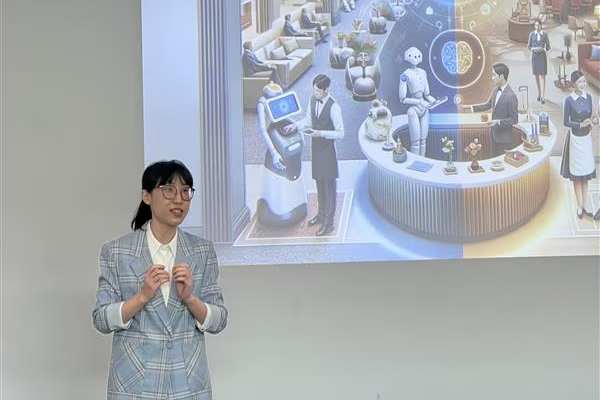
Mengni Fu echoes the sentiment. Despite the rapid adoption of AI, robotics, and automation in hospitality, human service remains vital. Her PhD research explores how Gen Z consumers and workers in China and Australia perceive these technological changes. Surveys of over 1,000 participants found strong support for technologies that replace tasks rather than people, though concerns about job security were prevalent, especially in Australia. While Chinese respondents were more comfortable with new technologies, they still preferred services where humans and technology worked together. “Sometimes we still need human warmth; we still need to talk to humans,” Fu says.
Frequently Asked Questions
How is AI changing the travel experience?
AI is streamlining travel by handling tasks like itinerary planning, hotel check-ins, and language translation. Travelers can use AI assistants to create highly personalised trips, receive real-time recommendations, and navigate destinations more efficiently.
Will AI replace human staff in tourism and hospitality?
Most research suggests AI will replace repetitive tasks rather than people. Humans remain essential for providing warmth, personalised service, and authentic interactions, which machines cannot fully replicate.
Can AI help reduce overcrowding at popular tourist spots?
Yes. “Smart tourism” initiatives use AI to analyse visitor patterns and suggest alternative routes, attractions, and times to prevent congestion, creating a smoother experience for tourists while protecting destinations.
Are there risks with using AI for travel planning?
Generative AI can produce inaccurate or misleading information, known as “hallucinations.” Travelers should verify details, seek local advice, and use AI as a guide rather than a sole source.
Does AI make travel less adventurous?
Technology can reduce some unpredictability, such as getting lost or encountering language barriers. However, it also opens opportunities to discover hidden spots, explore efficiently, and notice details that might have been missed. As Dr. Marianna Sigala notes: “Something is lost, but something is won.”
Will AI lead to fully virtual tourism?
AI-powered virtual reality, like digital replicas of landmarks, allows people to explore destinations online. While it can complement travel, it is unlikely to replace the physical experience entirely for most travelers.
Conclusion
AI, robotics, and smart tourism are transforming the way we travel, reshaping everything from itinerary planning to visitor management. While technology promises efficiency, personalised experiences, and reduced overcrowding, it also raises questions about what may be lost—the unpredictability, human connection, and small surprises that make travel memorable. Research shows that travelers and workers largely welcome AI handling routine tasks, but human interaction and warmth remain indispensable.
